
Split AC vs Window AC — The Most Common AC Confusion in India
Every summer, millions of Indian households face the same question — Split AC or Window AC? Furthermore, with electricity costs rising and summer temperatures reaching record highs across the country, this decision has never been more important to get right. Consequently, choosing the wrong AC type costs you more money, more electricity, and more discomfort over the appliance’s entire 10 to 15 year lifespan.
However, most online AC guides either oversimplify the comparison or bury the recommendation in jargon. Moreover, Indian home conditions — room sizes, wall thickness, flat vs independent house, rented vs owned properties — add specific nuances that generic international guides simply do not address. Therefore, this guide is built specifically for Indian buyers in 2026.
Subsequently, this guide covers every factor that actually matters — cooling performance, electricity bill, installation cost, noise, aesthetics, maintenance, and suitability for different Indian home types. Ultimately, you will have a clear, confident answer before spending ₹30,000 to ₹60,000 on an AC purchase. Thus, read through once and never second-guess your AC decision again.
❄️ Quick Answer for 2026: For most Indian households — especially flat owners and renters — a Split AC is the better choice. Furthermore, it is quieter, more efficient, looks better, and cools more evenly. However, Window AC is still the smarter pick for specific situations — ground floor independent homes, shops, offices, and buyers on tight budgets who want the lowest total installation cost. Consequently, there is no single universal answer — the right choice depends on your specific home and situation.
Split AC vs Window AC — Who Wins Each Category?
⚡ At-a-Glance Winner Per Category
- ❄️ Cooling Efficiency: Split AC wins — better airflow distribution, cools room more evenly
- 💰 Purchase Price: Window AC wins — typically ₹5,000–₹12,000 cheaper for same tonnage
- 🔧 Installation Cost: Window AC wins — one-time ₹500–₹1,500 vs Split’s ₹3,000–₹6,000
- 🔕 Noise Level: Split AC wins — indoor unit is nearly silent at 19–28 dB
- 🏠 Aesthetics: Split AC wins — sleek wall-mounted unit, no window blocked
- ⚡ Electricity Bill: Split AC wins — inverter tech widely available, higher star ratings
- 🔩 Maintenance: Window AC wins — simpler mechanism, single unit, easier servicing
- 🏢 Rental Homes: Window AC wins — no wall drilling needed, easier to shift when moving
Split AC vs Window AC — Complete 2026 Comparison Table
This table compares all important specifications and real-world factors. Moreover, the winner column gives you a quick verdict for each category before reading the full explanation below.
| Factor | Split AC | Window AC | Winner |
|---|---|---|---|
| Purchase Price (1.5 Ton) | ₹32,000–₹55,000 | ₹22,000–₹38,000 | 🪟 Window AC |
| Installation Cost 💰 Window Wins |
₹3,000–₹6,000 | ₹500–₹1,500 | 🪟 Window AC |
| Cooling Performance ❄️ Split Wins |
Excellent — Even distribution | Good — Directional airflow | 🌬️ Split AC |
| Noise Level (Indoor) | 19–28 dB — Nearly silent | 38–50 dB — Clearly audible | 🌬️ Split AC |
| Electricity Efficiency | 5★ inverter — very efficient | 5★ available — fewer options | 🌬️ Split AC |
| Aesthetics | Sleek — does not block window | Bulky — blocks window, light | 🌬️ Split AC |
| Maintenance | Two units — slightly complex | Single unit — simpler servicing | 🪟 Window AC |
| Suitable for Renters 🏢 Window Wins |
Requires landlord permission | Easier — minimal wall damage | 🪟 Window AC |
| Portability When Moving | Difficult — professional needed | Easier — single unit removal | 🪟 Window AC |
| Sleep Quality | Excellent — silent operation | Disturbing — constant hum | 🌬️ Split AC |
| Long-term Value | Better — lower electricity bill | Lower initial investment | 🌬️ Split AC |
Split AC vs Window AC — Side-by-Side at a Glance
These two cards summarise everything at a single glance. Furthermore, use them to immediately identify which AC type aligns with your household situation before reading the detailed category breakdowns below.
Split AC
Indoor + Outdoor UnitWindow AC
Single Combined Unit1. Purchase Price + Installation Cost — Total First-Year Investment
The sticker price is only half the story. Furthermore, installation cost is often ignored when comparing Split vs Window AC — and it makes a significant difference to your actual total spend. Consequently, always calculate total first-year cost before making the final decision.
Price + Installation Analysis
💰 Window AC Wins — ₹8,000–₹18,000 Cheaper UpfrontA 1.5-ton Split AC starts at approximately ₹32,000 and goes up to ₹55,000 for a premium 5-star inverter model. Furthermore, installation adds another ₹3,000 to ₹6,000 covering copper pipe fitting, bracket mounting, and electrical wiring. Consequently, total first-year cost for a Split AC easily crosses ₹38,000–₹60,000.
A 1.5-ton Window AC starts at approximately ₹22,000 and peaks around ₹38,000 for the best models. Moreover, installation requires only ₹500 to ₹1,500 for basic fitting into an existing window frame. Therefore, total first-year cost for a Window AC is typically ₹23,000–₹40,000 — a meaningful difference for budget-conscious buyers.
However, the lower upfront cost of Window AC does not tell the complete financial story. Conversely, a 5-star inverter Split AC typically saves ₹3,000–₹5,000 per year on electricity bills compared to a non-inverter Window AC used for 8 hours daily in summer. Subsequently, over 5 years, the electricity savings on a Split AC can recover the higher purchase price entirely. Ultimately, the Window AC wins on initial investment, but the Split AC often wins on total 5-year cost of ownership for heavy users.
✅ Window AC — Upfront Advantage
- ₹8,000–₹18,000 cheaper total first year
- Installation under ₹1,500 — minimal extras
- No outdoor unit bracket cost
- No copper pipe or wiring charges
- Budget under ₹28,000 — only real option
⚠️ Split AC — Long-Term Payback
- Higher upfront: ₹38,000–₹60,000 total
- Installation: ₹3,000–₹6,000 extra
- BUT saves ₹3,000–₹5,000/yr on electricity
- Pays back in 3–5 years for 8hr/day users
2. Cooling Performance — Which Cools Better and Faster?
Both AC types cool effectively — but the way they distribute cold air across a room is meaningfully different. Furthermore, for larger rooms and open-plan spaces common in modern Indian flats, this difference is noticeable in daily comfort.
Cooling Performance Comparison
❄️ Split AC Wins — More Even Room CoverageSplit AC units blow cooled air horizontally across the room from a ceiling-level indoor unit — this creates a natural downward circulation pattern that distributes cold air evenly throughout the entire room. Furthermore, modern Split ACs with 4-way auto-swing direct airflow in multiple directions simultaneously, eliminating hot spots near windows and corners. Consequently, the entire room reaches target temperature faster and maintains it more consistently.
Window ACs blow air in a single direction from one wall or window — consequently, areas directly opposite cool down well, but corners and far ends of larger rooms may remain noticeably warmer. Moreover, for rooms above 150 sq ft, Window ACs often struggle to maintain uniform cooling without leaving distinct warm zones. However, for smaller rooms under 120 sq ft, the difference in coverage quality is minimal in practice.
Additionally, Split AC compressors are installed outside — meaning they handle heat dissipation more efficiently, which directly improves cooling capacity in peak summer conditions above 40°C. Thus, for large bedrooms, drawing rooms, and open-plan areas common in modern Indian flats, the Split AC’s superior coverage makes a genuine daily comfort difference.
✅ Split AC — Cooling Advantage
- 4-way auto-swing — even entire room coverage
- Ceiling-level unit — natural downward airflow
- Outdoor compressor — better heat dissipation at 40°C+
- Large rooms 150–250 sq ft cooled evenly
- Reaches target temperature faster on hot days
⚠️ Window AC — Cooling Limitations
- Directional airflow — corners may stay warm
- Struggles in rooms above 150 sq ft uniformly
- Compressor shares room — reduces efficiency in heat
- Top floor rooms see more temperature variation
3. Noise Levels — Critical for Bedrooms and Sleep Quality
This is the single most important difference for bedroom use — and it is completely non-negotiable for light sleepers, children, and elderly family members. Furthermore, the noise gap between Split and Window AC is dramatic and immediately perceptible.
Noise Level Comparison
🔕 Split AC Wins — Indoor Unit Nearly InaudibleThis is the single most important difference for bedroom use. Furthermore, Split AC indoor units operate between 19 and 28 decibels — roughly equivalent to the sound of leaves rustling or a quiet library. Consequently, sleeping with a Split AC is genuinely comfortable for light sleepers, children, and anyone sensitive to background noise.
Window AC units house the compressor, fan motor, and all mechanical components inside a single unit placed in the room — producing continuous operational noise between 38 and 50 decibels. Moreover, this sound level is clearly noticeable in a quiet bedroom and often described as a persistent hum or rattle that can disturb sleep quality significantly. However, some users habituate to Window AC noise within a few weeks and stop noticing it consciously.
Therefore, for bedrooms, children’s rooms, home offices requiring concentration, and living rooms with frequent entertainment viewing, the Split AC’s near-silent operation provides a genuinely superior daily experience. Conversely, for shops, offices with background activity, or kitchens where ambient noise is already present, the Window AC’s noise level is rarely a meaningful issue.
✅ Split AC — Why Silence Matters
- 19–28 dB — equivalent to rustling leaves
- Compressor outside — zero mechanical noise inside
- Sleep undisturbed — critical for light sleepers
- Children’s rooms — no night-time disturbance
- Work-from-home calls — no AC noise in background
- Elderly parents — sensitive to noise disruption
⚠️ Window AC — When Noise Is Acceptable
- Shops and offices — background noise masks AC hum
- Kitchen — other appliance noise already present
- Deep sleepers — habituate within 1–2 weeks
- Ground floor rooms with road noise already present
4. Electricity Consumption — Monthly Bill Impact
The electricity cost difference between Split and Window AC depends on your daily usage hours and the specific models chosen. Furthermore, inverter technology availability is a key differentiator that significantly affects long-term running costs.
Electricity Bill Comparison
⚡ Split AC Wins — Inverter Saves ₹300–₹500 MonthlyA 5-star inverter Split AC (1.5 ton) consumes approximately 1.5 to 1.7 units per hour at peak cooling — and significantly less when maintaining temperature, since inverter compressors modulate their speed rather than cycling on and off. Furthermore, using a 5-star inverter Split AC for 8 hours daily across a 5-month Indian summer season costs approximately ₹6,500–₹8,500 in electricity at national average rates.
A non-inverter 5-star Window AC (1.5 ton) consumes approximately 1.7 to 2.1 units per hour — and because the compressor cycles fully on and off rather than modulating speed, peak consumption spikes occur regularly. Moreover, while 5-star Window ACs with inverter technology exist (Voltas, LG, Blue Star offer them), the model variety is more limited compared to Split ACs. However, for 4 to 5 hours daily casual use, the electricity cost difference between the two types is approximately ₹200–₹400 per month — meaningful but not dramatic for light users.
Therefore, heavy users who run their AC for 8 to 10 hours daily benefit most from the Split AC’s inverter efficiency. Conversely, for users running AC only 3 to 4 hours daily, the electricity savings from choosing a Split AC over a Window AC are relatively modest — and the lower upfront cost of Window AC may be the more practical financial choice for this usage pattern.
✅ Split AC — Electricity Advantage
- Inverter compressor — modulates speed, not on/off
- Saves ₹3,000–₹5,000/yr for 8hr/day users
- More 5-star inverter model options available
- Pays back price premium in 3–5 years
- Lower peak consumption spikes on power bill
⚠️ Window AC — When Electricity Gap Is Small
- 3–4 hrs/day use: only ₹1,500–₹2,000/yr difference
- 5-star inverter Window ACs do exist (limited range)
- Lower purchase cost partially offsets running cost
- Light users: payback period extends to 6–8 years
5. Installation — Especially Important for Renters
Installation requirements are radically different between Split and Window AC — and for renters in Indian cities who move frequently, this difference is often the most decisive factor in the entire decision.
Installation Comparison
🔧 Window AC Wins — Simpler, Cheaper, Less Wall DamageSplit AC installation requires drilling holes through external walls for copper refrigerant pipes, installing an outdoor unit bracket on the building exterior, running electrical wiring, and vacuuming the refrigerant lines — a process that takes 3 to 4 hours and costs ₹3,000 to ₹6,000. Furthermore, this work permanently modifies your home’s walls and structure, requiring landlord permission in rented properties. Consequently, many landlords refuse or demand restoration charges when tenants vacate.
Window AC installation simply involves fitting the single unit into an appropriately sized window opening, securing it with a frame bracket, and connecting to a standard power outlet. Moreover, installation takes 30 to 60 minutes, costs ₹500 to ₹1,500, and leaves no permanent wall damage. Furthermore, when moving homes, a Window AC can be removed and reinstalled in a new location for another nominal fitting charge — a genuinely significant practical advantage for renters in Indian cities who move frequently.
✅ Window AC — Installation Advantage
- ₹500–₹1,500 installation — minimal cost
- 30–60 min install — done same day
- No wall drilling or structural modification
- No landlord permission typically needed
- Relocate for ₹500–₹1,000 when moving flat
- No outdoor bracket or pipe work needed
⚠️ Split AC — Installation Considerations
- ₹3,000–₹6,000 installation — significant cost
- 3–4 hours — half-day process
- Permanent wall holes — landlord permission needed
- Outdoor bracket requires exterior wall access
- Relocation: ₹2,000–₹4,000 + pipe extension cost
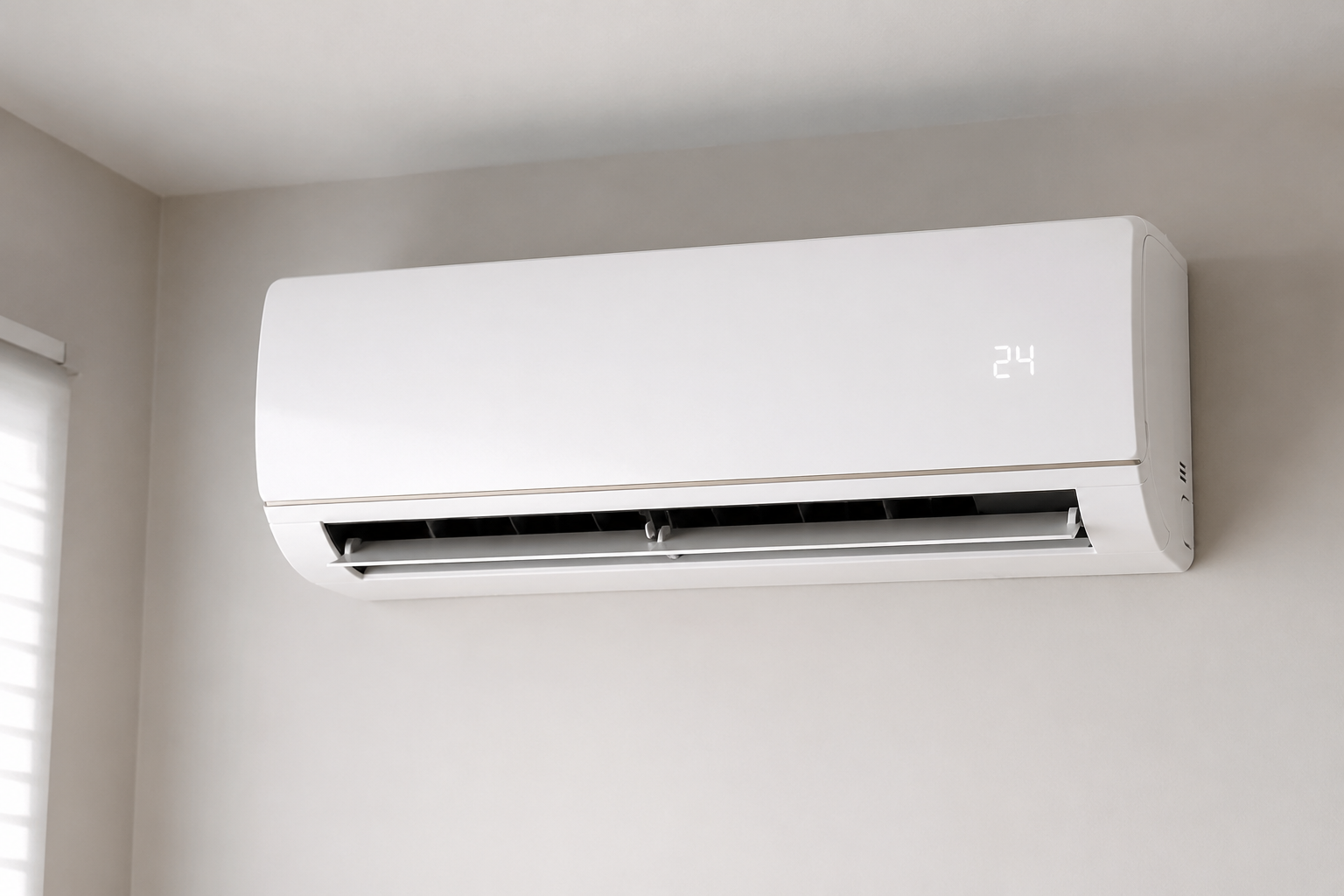
Split AC vs Window AC — Our Final Recommendation
After a complete and honest comparison of every factor relevant to Indian home buyers, here is the clear final recommendation for 2026.
Winner: Split AC — For Most Indian Flat Owners
For the majority of Indian flat and apartment owners — particularly those buying a bedroom AC or a living room AC for long-term use — the Split AC is the better overall investment. Furthermore, the near-silent indoor operation transforms the sleep and comfort experience in ways the Window AC simply cannot match regardless of price. Moreover, 5-star inverter Split ACs from Daikin, Hitachi, LG, Samsung, and Voltas deliver electricity efficiency that recovers the higher upfront cost within 3 to 5 years of daily use. Consequently, if you own your home, plan to live there for 3+ years, and are buying an AC for a bedroom or main living area — the Split AC is the smarter long-term decision in every meaningful way. Ultimately, the extra ₹8,000–₹15,000 in upfront cost is the correct investment for comfort, efficiency, and daily quality of life. Thus, choose Split AC — and choose a 5-star inverter model from a trusted brand.
🛒 Check Best Split AC Deals on Amazon →How to Choose Between Split AC and Window AC — 6 Key Questions
These six questions will help you identify the right AC type for your specific Indian home situation — faster and more accurately than any general comparison.
Do You Rent or Own the Property?
Renters should seriously consider Window AC. Furthermore, Split AC installation requires wall drilling that permanently modifies the property — many Indian landlords charge restoration costs or simply refuse permission. Conversely, Window ACs cause minimal wall damage, can be relocated when moving, and require only a suitable window opening. Therefore, renters in Indian cities who move every 1 to 3 years typically get better long-term value from a Window AC despite its limitations.
Is It for a Bedroom or Daytime Use?
For bedrooms — especially if you or family members are light sleepers — the Split AC’s near-silent operation (19–28 dB) is transformative. Furthermore, a sleeping child or elderly parent disturbed nightly by Window AC noise (38–50 dB) is a meaningful quality-of-life problem that justifies the higher Split AC cost entirely. Conversely, for shops, offices with regular background noise, and kitchens, Window AC noise is rarely a daily issue and the lower cost makes more sense.
What Is the Room Size?
For rooms up to 120 sq ft, a 1-ton Window AC cools adequately and uniformly. Furthermore, for rooms between 120 and 180 sq ft, both types work with a 1.5-ton unit — but Split AC covers the room more evenly. Moreover, for rooms above 180 sq ft, a Split AC is strongly recommended since Window AC’s directional airflow struggles to reach distant corners effectively. Therefore, match tonnage to room size and choose AC type based on room dimensions.
How Many Hours Daily Will You Run It?
For daily use of 8+ hours — bedroom all night, or daytime WFH use — a 5-star inverter Split AC pays back its higher price through electricity savings within 3 to 4 years. Furthermore, at 8 hours daily for a 5-month summer, the annual saving of a 5-star inverter Split over a non-inverter Window AC can reach ₹3,000–₹5,000. Conversely, for 3 to 4 hours daily casual use, the electricity saving difference is only ₹1,500–₹2,000 per year — making the Window AC’s lower upfront cost the more practical choice.
Do You Have a Suitable Window?
Window AC requires an existing window opening of adequate size — typically 70×55 cm or larger. Furthermore, sliding windows work best, while fixed glass windows require professional modification. Moreover, if the suitable window faces directly west into afternoon sun, Window AC performance may suffer. Conversely, Split AC installation only needs a small 7cm hole through the wall for refrigerant pipes — suitable for virtually any room regardless of window type or position.
What Is Your Total Budget Including Installation?
Always calculate the total first-year cost — not just the AC sticker price. Furthermore, add ₹3,000–₹6,000 for Split AC installation, or ₹500–₹1,500 for Window AC installation. Consequently, a ₹32,000 Split AC with ₹5,000 installation costs ₹37,000 total — while a ₹24,000 Window AC with ₹1,000 installation costs only ₹25,000 total. Therefore, be honest about budget before choosing based on features alone.
💡 Pro Tip — Always Buy 5-Star Rated AC in 2026
The difference in electricity consumption between a 3-star and 5-star AC of the same tonnage is approximately 20 to 28% per year. Furthermore, at 8 hours daily use through a 5-month Indian summer, this translates to ₹1,800–₹3,500 in annual electricity savings. Moreover, the price premium between 3-star and 5-star models of the same brand and type is typically only ₹3,000–₹6,000 — recovered through electricity savings within 2 years. Consequently, always invest in the 5-star model regardless of whether you choose Split or Window AC. Therefore, never buy below 4-star BEE rating for any AC in India in 2026 — the electricity bill difference over 10 years is genuinely significant.
Final Verdict — Split vs Window AC: Who Should Buy What?
Use this to find your exact recommendation based on your specific situation. Choose based on your real circumstances — not the most expensive option available.
Ultimately, neither Split AC nor Window AC is universally superior — the right choice depends entirely on your home ownership status, room type, budget, and daily usage hours. Furthermore, the guide above covers every scenario an Indian buyer encounters. Consequently, use the verdict for your specific situation, buy a 5-star rated model from a trusted brand, and stay cool this summer — no second-guessing needed. Thus, your AC decision is now settled.
Split AC vs Window AC — Common Questions Answered
❤️ You May Also Like
More home appliance and buying guides for Indian homes